Jed Leeder
House of LeavesJed Leeder’s decisive role in The Navidson Record is to embody competence under pressure and then expose how completely the house can invalidate ordinary human abilities. Originally a career truck driver from Vineland, New Jersey, he discovers the Cascades, abandons trucking, and becomes a seller of camping gear in Seattle. His shyness, endurance, and exceptional orientation initially mark him as the expedition’s quiet reliable figure; inside the labyrinth, however, even his famed sense of direction fails, leaving him responsible for a badly wounded Kirby “Wax” Hook while Holloway Roberts has lost contact with reality.
Identity and Background
Jed Leeder lives in Seattle but remains associated with Vineland, New Jersey, where he grew up. His life changes when a transcontinental trucking job takes him to Washington and he sees the Cascades for the first time. The encounter is described as an immediate conversion: he quits his job and begins selling camping equipment, and six years later his attachment to the Pacific Northwest and its outdoors has intensified rather than faded.
His physical and temperamental profile contrasts with his later importance. Jed is consummately shy, almost frail in manner, yet possesses remarkable endurance and an uncanny sense of direction. Holloway Roberts concedes that Jed could probably outdistance him on a climb without a pack. Outside expeditions, Jed drinks coffee, watches the tide turn, listens to Lyle Lovett with his fiancée, and speaks softly about her Texas origins and their hoped-for marriage. These domestic details establish him not as a mythic adventurer detached from ordinary life, but as a young man whose ambitions coexist with routine affection and a recognizable future.
Entry into the Expedition
Jed joins Holloway Roberts and Kirby “Wax” Hook after Billy Reston sends Holloway a tape of the Five and a Half Minute Hallway. Holloway arrives at the house within a week, bringing Jed and Wax as employees. Jed is therefore recruited through a chain that begins with recorded evidence and proceeds through professional trust: Reston knows Holloway from an arctic-gear symposium, and Holloway’s response to the tape brings the team into the house.
Within that team, Jed functions as the restrained counterpoint to Wax’s prodigious climbing confidence and Holloway’s authority. His particular gift is not flamboyance but orientation: he can navigate, persist, and continue when others might be overwhelmed. The expedition consequently depends on a skill that appears practical and almost modest until the house’s architecture begins to behave unlike any ordinary terrain.
The Wounding of Wax and Holloway’s Collapse
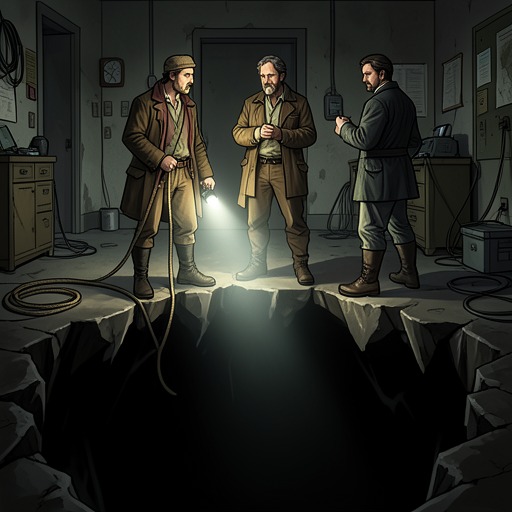
Jed’s central ordeal begins after he and Wax reach a cache near the entrance to an unexplored corridor. The food and fuel are gone, but a water jug remains intact. When Wax bends to drink, a rifle cracks and he falls with blood gushing from his left armpit. Jed immediately crouches beside him and applies pressure to the wound.
The shooter is Holloway, who emerges from the dark corridor carrying the rifle. He appears shocked both by the sight of Jed and Wax and by the stairs, and his confusion reveals that he no longer possesses a stable account of where he is or what he has done. Holloway asks how he arrived there and insists that he believed he was being pursued by “that thing.” Jed is thus forced to respond simultaneously to a physical emergency and to the breakdown of the expedition’s leader.
The scene overturns the team’s hierarchy. Holloway’s expertise and command no longer guarantee safety; his rifle makes him an immediate danger. Jed, the quiet subordinate, becomes the person who must preserve Wax’s life and interpret the disintegrating circumstances around him. The labyrinth does not merely obstruct movement. It converts knowledge, authority, and equipment into sources of uncertainty.
Carrying Wax Through the Labyrinth
After Holloway’s break with reality, Jed moves Wax to another room and tries to find a route back to the staircase. He continues despite exhaustion, pursuit, and disorientation, managing to carry, drag, and push Wax toward relative safety. The effort is an inversion of his defining ability: the man whose sense of direction once distinguished him can no longer locate the way out.
At 3:31 A.M., Jed speaks into the camcorder because it may be his only means of explaining what has happened. His recorded account makes the emergency brutally concrete: the radio is useless, he cannot find the staircase, and without prompt help both he and Wax may die. His statement is not a triumphal explorer’s report but a survival document, preserving a witness at the exact point where orientation, communication, and bodily strength are failing together.
Jed’s repeated knocking deepens this problem of communication. His fist strikes the floor with a timbre identical to the knocks previously heard in the living room, suggesting a possible acoustic connection across the house. Yet the rhythm does not resemble the three-short, three-long, three-short SOS pattern. The disagreement among commentators over whether the pattern matters, or whether the team’s silence has itself become a distress signal, places Jed’s suffering inside the larger uncertainty surrounding the house’s ability to carry and interpret sound.
Rescue and Narrative Significance
Navidson eventually approaches the obstacle separating the trapped men from the rescuers. Hearing a whimper beyond it, he repeatedly throws his shoulder against the door until the fourth impact tears free the hinges and sends the door to the floor. Reston’s camera captures Jed’s ashen face as he confronts what he believes is his final moment.
The immediate result is a violent emotional reversal. Jed’s rasp of terror changes almost instantaneously into laughter and sobs of relief when he realizes that the sentence he expected has been remitted. The rescue does not erase the ordeal or restore his former certainty; instead, it makes visible the cost of survival. His defining arc moves from confident orientation in the outdoors, through total spatial and psychological dislocation, to a return made possible by social contact and another person’s physical intervention.
Jed’s trajectory also clarifies the book’s treatment of exploration. He is neither a reckless invader nor a detached specialist. He enters the house with practical skills, a fiancée, and a future imagined beyond the expedition. The labyrinth reduces those assurances to immediate bodily stakes, then returns him to the world through a fragile chain of recording, endurance, companionship, and rescue. His story gives the expedition one of its clearest measures of the house’s power: if even Jed Leeder can become lost, then the failure belongs not simply to the explorer but to the space itself.